The Standard for Interchangeable Microservices
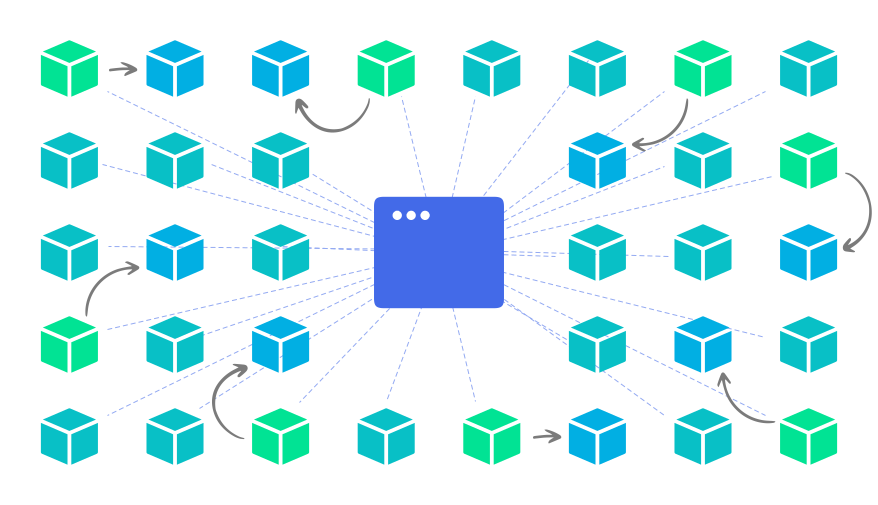
The Open Microservices Initiative is creating a unified semantic protocol for domain-specific services. By codifying shared data models and communication semantics, OMI ensures that microservices are inherently interchangeable and architecturally transparent. It provides the foundational framework that eliminates the necessity for redundant backend implementation by promoting a global ecosystem of standardized, pluggable components.
Learn about OMI's core principlesThe TLDR
The Open Microservices Initiative (OMI) is a collaborative effort to establish a universal standard for domain specific microservice architecture. By defining a comprehensive ontology for common business domains, OMI enables the creation of interchangeable and interoperable services. This standardization reduces redundant development efforts, enhances system resilience, and facilitates seamless integration across diverse technological ecosystems. OMI aims to transform the way software systems are built and maintained, promoting efficiency, scalability, and adaptability in an increasingly complex digital landscape. It is not a framework, library, or platform, but a set of principles and specifications that guide the design and implementation of microservices to ensure they can be easily swapped and integrated.
Why OMI?
In addressing the question of “Why OMI?”, one must first acknowledge that contemporary software architecture is frequently characterized by idiosyncratic and bespoke service implementations, leading to a state of perpetual redundancy, or in short, we write the same code over-and-over again. In the absence of a unified semantic framework, foundational business domains, such as identity management, transaction processing, inventory orchestration, and many more, are repeatedly reconstructed across different projects. This lack of standardization results in significant semantic drift, where identical business logic is expressed through incompatible APIs and isolated data structures. Consequently, engineering resources are disproportionately allocated to the maintenance of primitive infrastructure rather than the advancement of unique value propositions.
The Open Microservice Initiative (OMI) serves to rectify this fragmentation by formalizing a rigorous set of ontological standards for distributed systems. By codifying shared communication protocols and data semantics, OMI facilitates a strategic transition from artisanal service construction to standardized modular assembly. This initiative establishes a substrate of universally trusted and interchangeable primitives, ensuring that any compliant service can be integrated with architectural transparency. Ultimately, OMI provides the necessary framework for a resilient digital ecosystem where backend logic is no longer a recurring engineering hurdle, but a ubiquitous and standardized utility.
Roadmap
The progression of the Initiative is categorized into four strategic epochs, moving from foundational codification to the realization of an autonomous, composable ecosystem.
Codification & Formalization (Active)
Establishing the core legal and technical mandates that define the Initiative.
Tooling & Enablement
Providing the developer community with the mechanical means to achieve compliance.
Ecosystem Expansion
Fostering industry adoption and building a critical mass of interchangeable services.
Autonomous Composition
Realizing the future of AI-driven, programmatic service orchestration.
For the detailed roadmap and upcoming milestones, visit our Roadmap Page.
Join the Movement
The Open Microservices Initiative is an open and collaborative effort. We invite developers, architects, and organizations to contribute to the evolution of this transformative standard. By participating in OMI, you become part of a movement towards a more efficient, interoperable, resilient, and future-proof software ecosystem. To get involved, visit our Contribute Page and explore the various ways you can help shape the future of microservices.